
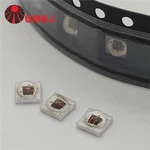
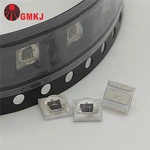

We are acquiring cutting-edge technology to ensure that our deep red led, 460nm led, power led 100w is competitive in both the domestic and international market. Our goal is to become a world-famous enterprise and strive to become a world-famous enterprise with diversified development, high sense of social responsibility and sustainable development ability under the background of economic globalization. We will pay more attention to preventing and resolving risks, and strive to maintain high-quality development to ensure the achievement of the set strategic goals. We have the strength and ability to help you make reasonable plans according to your needs and actual production situation, and provide you with more economical and reasonable types of products and solutions. We understand that the construction of corporate culture is a long-term project, which requires unremitting efforts and time precipitation in order to cultivate excellent corporate culture and play the role of enhancing the competitiveness of enterprises through corporate culture.
275nm LED 280nm UV 6868 Germicidal
● low voltage operation
● Instant light
● Long operating life
● Disinfection sterilization
● High radiance density,suitable for impact design.
● Air sterilization, water sterilization
● Medical treatment and skin disease treatment

Product Features
Application:
Disinfection, Phototherapy, Fluorescent Spectroscopy, Sensor Light,
Bio-Analysis / Detection, Counterfeit Detectors, etc
Chip Brand: LG or Epileds
Base Material: High Thermal conductivity Aluminum Nitride Base
Wire Brand: Germany Heraeus Gold wire.
Radiant Power: 40-60mw
Forward Current: 100-150mA
Forward Voltage: 20-32V
Dimension: 3.5x3.5 x1.35mm
View angle: 120 degree
Working Temperature: -30ºC -- + 60ºC
Certificates : LM-80. CE. Rohs,Fcc .
Product Dimension

Product Specification
Absolute Maximum Ratings(At TA =25℃)
|
Parameter |
Symbol |
Rating |
Unit |
|
DC Forward Current |
IF |
150 |
m A |
|
Peak pulse Current* |
IFP |
150 |
m A |
|
Power Dissipation |
PD |
4 |
W |
|
Operating Temperature Range |
TOPR |
-30 ~ +75 |
°C |
|
Storage Temperature Range |
TSTG |
-40 ~ +85 |
°C |
Electrical/Optical Characteristics--White (At TA=25°C)
|
Parameter |
Symbol |
Conditions |
Min |
Avg. |
Max |
Units |
|
Forward Voltage |
VF |
IF=150mA |
20 |
-- |
32 |
V |
|
Thermal Resistance Junction To Board |
RΘJ-B |
IF=150mA |
-- |
8 |
-- |
°C/W |
|
Radiant Flux |
Φe |
IF=150mA |
40 |
60 |
mW |
|
|
Peak wavelength |
λp |
IF=150mA |
265 |
285 |
nm |
|
|
Temperature Coefficient of Forward Voltage |
∆VF/∆T |
IF=150mA |
−− |
-2 |
−− |
mV/°C |
|
Reverse Current |
IR |
VR=5V |
−− |
−− |
10 |
μ A |
|
Viewing Angle [1] |
2Θ1/2 |
IF=60mA |
−− |
100 |
−− |
Deg |
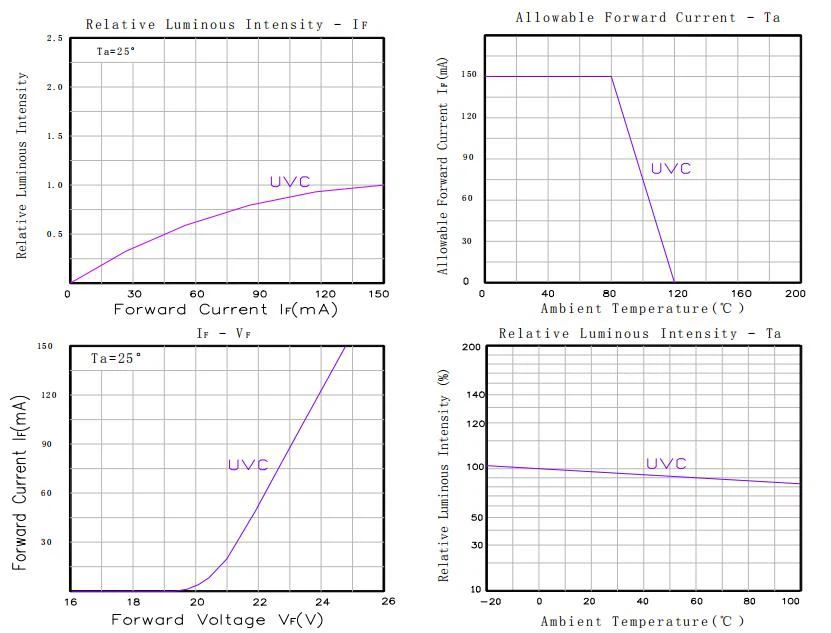
Typical Optical/Electrical Characteristics Curves

SMT REFLOW SOLDERING INSTRUCTION

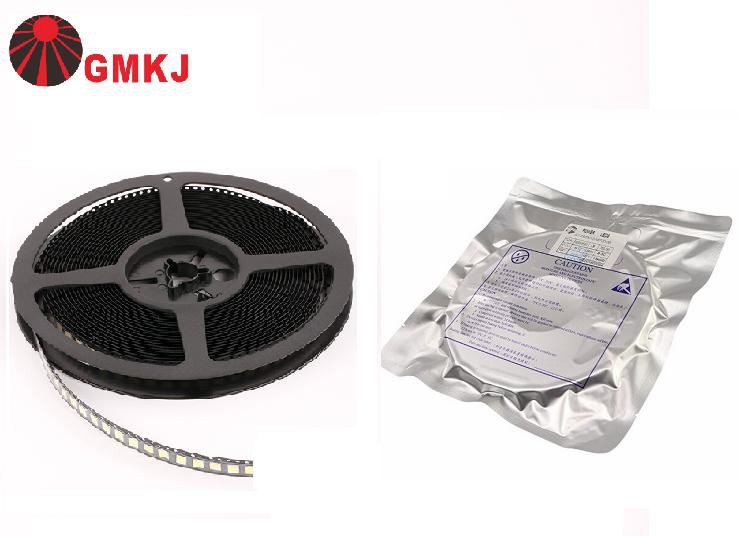
Packing Method
Shipping Method
●Order Qty<1000pcs, 3-5 workdays.Delivery time:
●Order Qty>10000pcs, 7-12 workdays.
●Order Qty>50000pcs,12-20 workdays.

Production Flow

Q&A
Is far UV (200 – 225 nm) a promising disinfection technique to address COVID-19 and other pathogen disinfection?
Yes, but as with all UV-C solutions we need accurate inactivation (dose) response curves to determine the UV exposure (UV dose) required for the desired level of disinfection. Based on existing literature it is expected that far UV-C will be effective in inactivating SARS-CoV-2 given sufficient UV exposure.
Is far UV (200 – 225 nm) 'skin safe'
Perhaps, but more research is required.
Far UV-C is high-energy radiation which can directly damage DNA and key organic molecules such as proteins. The biophysical basis for the claims that far UV-C is ‘skin safe’ is that the damaging radiation is entirely absorbed within the outer, dead, layers of skin and does not reach the inner, live, cells; if the radiation were to hit these cells, they would be damaged as a result. A number of studies have been published discussing acute and chronic exposure to far UV-C, most commonly using Kr-Cl excimer lamps. These studies have investigated the effect of far UV-C radiation on mice by measuring key chemical and physical changes known to indicate damage from UV-C exposure. It was found that these same damage indicators were not observed under far UV-C irradiation. (Yamano et al. , 2020; Buonanno et al., 2017; Narita et al., 2018) However, these studies only considered known damage indicators, and ‘longitudinal studies’ investigating negative impacts from unknown side effects have not been conducted.
Additionally, the exposure of humans to ultraviolet radiation is the subject of numerous regulations and standards worldwide: 2006/25/EC (Europe), ACGIH 2008 TLVs and BEIs (USA), and IEC 64271 (CB Scheme, global) all employ an actinic UV hazard curve which lists far UV-C as harmful, though at a weighting of 10-30% of that at the conventional UVGI wavelength of 254 nm. These standards therefore define an upper limit to how much far UV light the human body can be exposed to. This would then need to be compared to the dose that is required for the purpose for which the far UV device was designed.
Does far UV (200 – 225 nm) generate ozone?
From a photochemical perspective, yes.
The Chapman cycle (Chapman, 1930) describes the counteractive processes of ozone formation and degradation from the interaction of light with molecular oxygen (O2) and ozone(O3). The rate of generation of ozone by far UV-C (known as the Herzberg continuum in atmospheric science) outweighs the rate of its degradation; the tipping point at which this generation/degradation balance flips is ~242 – 243 nm. (Andrew et al., 2003; Santos, Burini, and Wang, 2012), Far UVC (200-225 nm) only generates ozone in the upper atmosphere, where path lengths are very long. In a normal laboratory setting, ozone would not be generated because oxygen (O2) is a very weak absorber in the far UVC region.
As with any process, the risk of such hazards should be assessed on an application-by-application basis. A low power lamp operated in a well-ventilated area may not generate a measurable ozone concentration; a high-power system in an enclosed space may constitute a substantial risk.
For more information, or if you are at all uncertain, please contact your vendor for guidance and apply suitable risk management procedures.
Company Environment

Factory Environment

Shenzhen Guangmai Electronics Co.,Ltd is a High-Tech firm founded in 2005 with registered capital 30 million RMB. We specialize in the development of LED products, owning a experienced and skilled engineer team team to meet customers' demand.We are the first choice for lighting project in LED.
With many years of led technology and rigorous management,we received the praise and trust from clients.Our philosophy is " focus on technology,provide the best LED" ,making good quality products and bringing more value to our clients.We are your honesty partner in the world and make a contribution to the green light industry.GMKJ is fighting to achieve the goal of "To be the best LED lighting supplier" .
We try for excellence, service the customers', hopes to be the most effective cooperation workforce and dominator company for staff, suppliers and shoppers, realizes price share and ongoing marketing for UV LED 275nm UVC LED Light UV Sterilizer LED. Opportunities and efforts are indispensable. Opportunities must be seized, and only after hard work can they be organically circuitous. We strive to provide our customers with the best and most affordable products, and we always ensure to provide high-quality products within our product range.
Hot Tags: 275nm LED 280nm UV 6868 germicidal, China, manufacturers, suppliers, factory, price, cheap, quotation, datasheet, specs, specification, philips lumileds 3030, warm white cob led, 650NM LED Red 2835 Plant Grow, 2835 led chip, Led Smd 3030 Bridgelux Dual Chip, led cob 60w
[[ProKeywords]]


