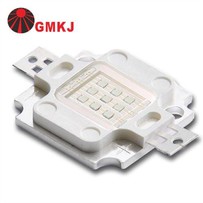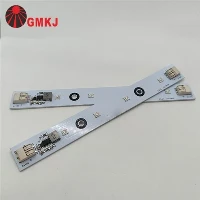
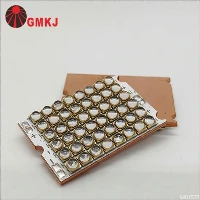


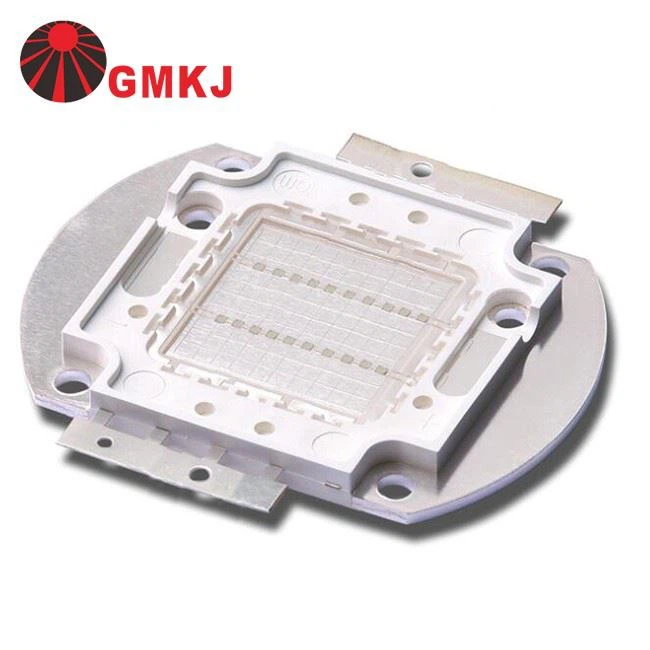


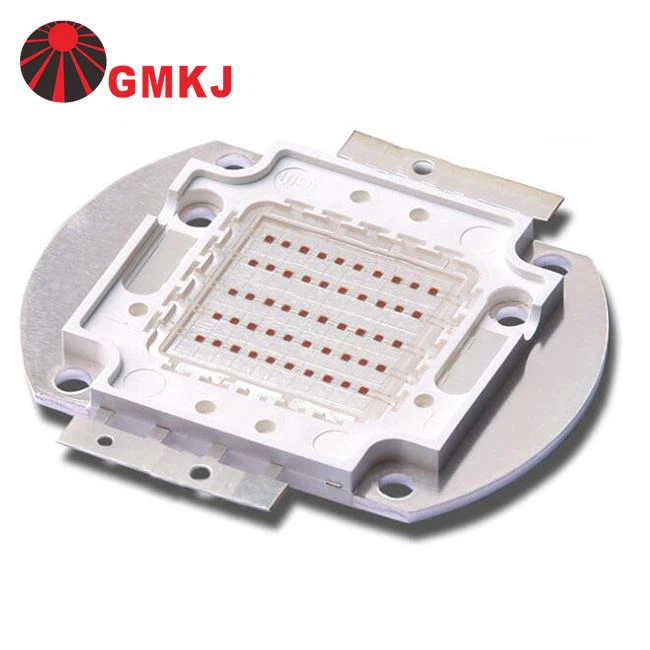
Guangmai Technology is professional in making the LED COB infrared 850nm 50W 100W Chip.
Misunderstandings in the use of infrared LEDs in security surveillance cameras
1. The importance of heat dissipation is relatively neglected: we often use too small heat sink or no heat sink at all. It is important to know: Poor heat dissipation will result in high operating temperature of the chip, resulting in infrared wavelength drift and reduced photoelectric conversion efficiency. The high wavelength, exceeding 850nm, causes the camera's CCD to have poor light sensitivity, that is, the night vision effect becomes worse. Low photoelectric conversion efficiency means insufficient brightness. Often a few cents of heat sink will produce the big effect of the small soldiers making great contributions.
2. Wrong hand touch to test the temperature: people often get shocked by themselves, because they can't bear it in less than 2-3 seconds when they put their hands on the shell (or heat sink) over 44 degrees Celsius, so I feel "Too hot", in fact, the temperature is not high and will not harm the normal operation of electronic components at all. Moreover, the higher the temperature of the housing (or the heat sink), the better the heat dissipation. "Energy is indestructible"---Imagine: The shell (or heat sink) is not hot. Where does this "heat" go? The heat stays on the chip and cannot be led out, which causes the chip to work under high temperature, and the night vision effect is poor, the light decay is large, and the lifespan is short.
3. Think that a larger chip must be "brighter" than a smaller chip: Therefore, LEDs that require large-size chips are often blindly designated. You know: the brightness depends on the current, how much current can be used? It depends on the processing of heat dissipation, that is: heat dissipation determines the current and thus the brightness, not the size of the chip determines the brightness. In theory, regardless of the size of the same brand of chips, if the current and voltage are the same (same power), the heat generated will be the same. The question is: How much area is the same heat spread? Scattered on the pinhole-sized area and the palm-sized area, the difficulty of heat dissipation is greatly different. In terms of heat dissipation, each company has different technologies, equipment, and heat dissipation materials. Therefore, each company has a different ability to deal with the same "heat" in how much area.
For example: if you provide 1.2A current on Epistar 28mil chip and 42mil chip, the voltage is slightly the same (about 1.7V), so the power is slightly the same (about 2W), and of course the heat generated is similar. The problem is: It is easier to dissipate the 2W heat on the area of the 42mil chip, but it is more difficult to disperse it on the 28mil chip. Using traditional silver glue to "bond die" packaging method, its thermal resistance is generally 20°C-30°C/W, and using eutectic technology packaging, its thermal resistance is generally 6°C-10°C/W. It shows that the heat dissipation effect is completely different. The driving currents that can be used by the above two are greatly different, and the brightness is also very different.
Of course, the use of advanced heat dissipation technology to select small chip packaging and high current driving methods is also limited. If the above 2W heat is placed on the area of a 10mil chip, even if it is packaged with a eutectic process, it is currently difficult to smoothly and completely heat the Export. Looking forward to the future, with better heat dissipation technology and materials, it may be possible to achieve more advanced infrared LEDs with smaller chips and lower prices, but with the same night vision effect.
To sum up: the night vision effect of a large-size chip may not be stronger than that of a small-size chip, depending on the quality of the heat dissipation process. Therefore, the packaging technology of the eutectic process is one of the important means for the improvement of cost performance at present, and it should be the future trend.
LED COB infrared 850nm 50W 100W Chip package size:


LED COB infrared 850nm 50W 100W Chip application:

About Guangmai LED/ GMKJ LED

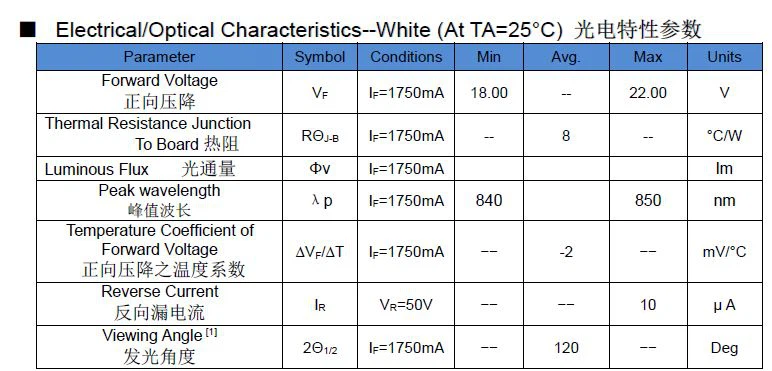
Datasheet:
For more details, please feel free to contact with Guangmai Tech directly.
You can download the English Version datasheet of LED COB infrared 850nm 50W 100W Chip from the head of this page.
Hot Tags: led cob infrared 850nm 50w 100w chip, China, manufacturers, suppliers, factory, price, cheap, quotation, datasheet, specs, specification