

Can "full-spectrum LED lights" for plant cultivation completely replace sunlight?
We know that the growth of plants requires the exchange of nutrients through photosynthesis. After the plants are illuminated, the chlorophyll on the leaves of the plants can convert the carbon dioxide and water in the leaves into glucose, and the glucose is further turned into starch. Wait for organic matter to provide energy for plants to grow normally.
Light is like our human food. If there is no food, we will starve to death, but without light, the entire metabolic process of the plant will disappear and it will die.

Therefore, under normal circumstances, plants can grow, develop, bloom and bear fruit only when there is light. All the flowers or plants we cultivate need light, but different types of plants have different requirements for light intensity and sunshine length.
On a sunny day, the light directly irradiated by the sun is called direct light. Plants that like the sun need to be cultivated under direct light. If it is cloudy or the light in a sheltered place is called scattered light, shade-loving plants should be planted in a shady place. It can grow well as long as there is scattered light.
Spectrum of natural light
In most cases, the light required for photosynthesis refers to natural light, that is, the light emitted by our sun, but when these sunlight are used for photosynthesis by plants, the wavelength band available to plants is about 400-700nm. The utilization rate of each wavelength is not the same between the wavelengths. The complex mixed light in sunlight, arranged through different wavelengths, is the spectrum of sunlight, which includes the spectral curves of ultraviolet light, visible light, and infrared light. The spectrum of sunlight can be called the full spectrum.
Spectral principles of artificial light
In the artificial light source, the working principle is to appropriately increase the content of the chemical element mercury in the light-emitting arc tube of the arc discharge gas discharge lamp, thereby increasing the light energy of the ultraviolet light part, and by adjusting the content ratio of the metal halide, the visible light part is made. The combination of wavelengths in each band can be close to the solar spectrum.
Artificial light sources need to be in the visible light range between 400-800 wavelengths, so that the spectrum is constantly approaching sunlight, which is the most high-quality light source for color rendering.
There is only one goal that artificial light sources are constantly approaching, that is, the color temperature of sunlight changes with the four seasons and the time of morning and evening, so the spectrum of full-spectrum lamps should change the color temperature successively with time to simulate the natural light environment. Plants can adapt to changes in climate and temperature in order to be more in line with the natural growth laws of organisms.
Compared with ordinary LED sunlight, what are the advantages of full spectrum?
At present, indoor plant lighting mainly uses a combination of red and blue LEDs, or a combination of red and white LEDs. It is not difficult to see from the spectrogram that although the spectrum of the incandescent lamps used for a long time before is unevenly distributed, the spectrum is relatively comprehensive. Under the condition of a certain degree of illumination, it still has a certain promotion effect on the growth of plants, but this This kind of light has the disadvantages of too low efficiency, relatively large energy consumption and short service life.

There are also sodium lamps and energy-saving lamps that are common in the market. The curve of such lamps varies greatly and the spectral distribution is uneven. The red and blue ratio of ordinary LED plant lamps has certain advantages, but the spectrum and the full spectrum of sunlight are incomparable. , and from a cost perspective, the cost is high, the light color is purple, which is not beautiful, and the brightness is not enough.
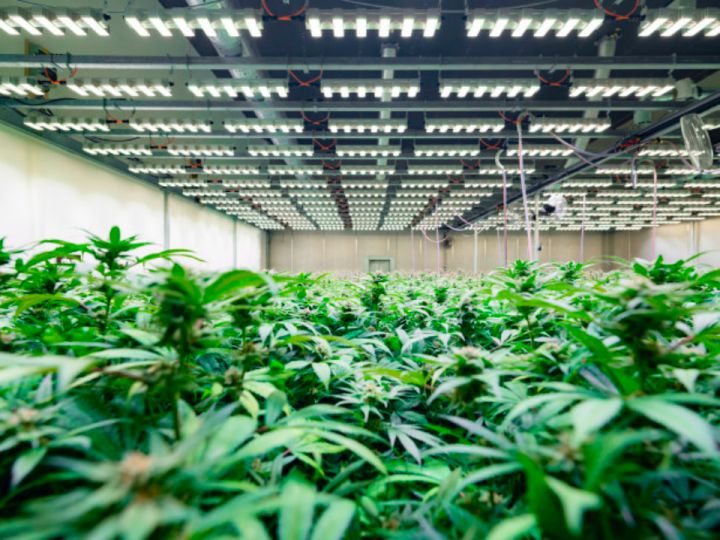
Therefore, comparing the above, it is not difficult to find that the current full-spectrum plant light is the closest to the full spectrum of sunlight in plant applications, and is the most ideal for agricultural greenhouses, agricultural research institutes, agricultural ecological parks, and large-scale office landscape plants. Fill light source.
The current full-spectrum research and development of LED light sources has been going on internationally for many years, but the technology is limited to the development of visible light parts in each band to achieve continuous spectrum and improve the color rendering index, but it is difficult to achieve continuous spectrum in the ultraviolet and infrared light parts.
The spectrum of each ultraviolet and infrared LED lamp bead is very narrow, and it is limited to a certain frequency band, combined into a continuous spectrum, the effect is not satisfactory, and the manufacturing cost is not low. As LED lighting technology continues to deepen in the field of plants today, the real test of expertise and technology lies in the ability to provide consistent growing conditions and rational use of energy, while ensuring high-quality crops for growers and end users. Most TCO calculations rely on efficient, sustainable long-term light output.

Plant lighting is a steadily growing market, and technology is constantly advancing. This is an era of technological innovation. It is believed that human beings will eventually change their lives through technology. Full-spectrum plant growth lights are based on the laws of plant growth, simulating solar spectrum distribution. According to the principle of ratio, the developed artificial light source with full spectrum has a wide radiation range, reaching more than 100LM per watt, which truly meets the requirements of green lighting.
Regardless of the weather, season and time of day, plants, like humans, need light as they grow, and it is critical to use the right light strategy. For agricultural greenhouses, full-spectrum lights are used as supplemental light, which can be enhanced at any time of the day so that plants can always assist in photosynthesis. Especially in the winter months, the effective lighting time can be extended. No matter at dusk or at night, it can effectively extend and scientifically control the light required by plants, and is not affected by any environmental changes. In a greenhouse or plant laboratory, it can completely replace natural light to promote plant growth.


