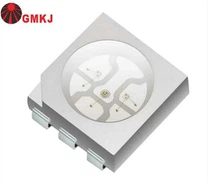
Wireless bonded LED technology, often referred to as “flip chip”, offers several key performance benefits over traditional SMT (Surface Mount Technology) LEDs including enhanced durability, enhanced heat dissipation and superior light performance.

GMKJ LED has launched a product family of wireless bonded LEDs. These GMKJ “flip chips” are up to 15% brighter than any others in the market. In addition to the standard 3W and 6W LEDs, GMKJ's wireless bonded LED is also available in 20-100W.
Applications for the GMKJ Wireless Bonded LED include:
Automotive – daylight, running light, dome light, foot well and floorboard runner lighting
Appliance – cabinet lighting, accent lighting, backlighting
Industrial control – donut lighting, warning indicators, inspection lighting
Medical – surgical lights, examination lights, oral surgery lighting
Signage – channel lighting, backlighting, warning and hazard lights
Construction – warning lights, light towers, traffic lights
Military – heavy equipment, construction and transportation lights
The enhanced shock and vibration resistance of wireless bonded LEDs compared to traditional LEDs stems from its more durable design. Due to the absence of a wire bond and a hard epoxy layer, the wireless bonded LEDs are five times stronger and more robustly designed than standard, high power LEDs.
Wireless bonded LEDs offer superior heat dissipation and are more adverse to shock and vibration than traditional high power LEDs. They can withstand higher temperatures without compromising performance and have a greater surface area for heat dissipation, making them more efficient at removing heat. Due to the placement of junction pads on the bottom of the flip chip, heat can be transported faster than with a regular high power LED, keeping this technology 25% cooler than traditional high power wire bond technologies.
Wireless bonded LEDs provide superior light performance compared to conventional LED technology. Higher light output is achieved in a more compact space and the light performance is not disrupted by shadows or other obstacles to consistent performance. With wireless bonded technology the chip can directly emit light from the top and the side with no wire bond casting shadows or creating uneven light distribution, providing 15% more light output.