

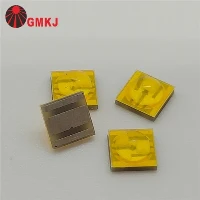


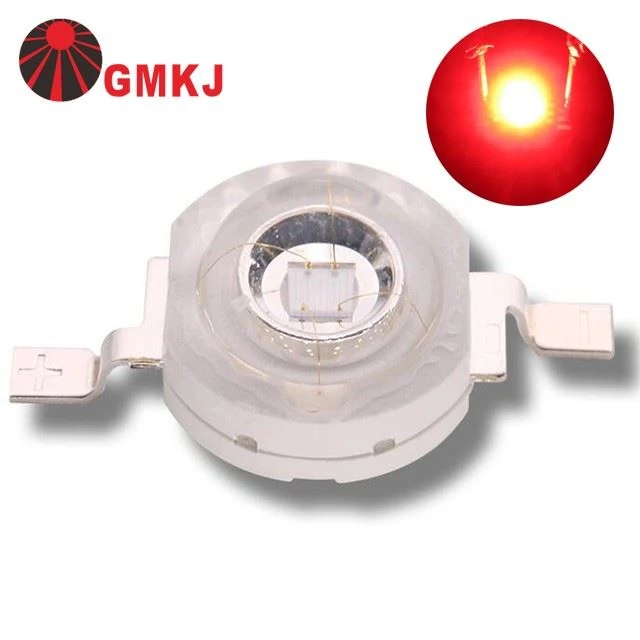
Item Name: 3W 730nm Power LED
Model Number: GP-3WFR-G42
Input Current: 700mA
Power: 3W
Input Voltage: 1.6-2.0VDC
LED package type: Copper high power LED package
Chips brand: Taiwan Epileds
Chip size: 42*42mil
Color: 730-740NM
There are two effects of 730nm far-red LEDs on plants
1. Shadow avoidance of far-red light at 730nm
One of the most important effects of 730nm far-red illumination on plants is shade avoidance.
If a plant is exposed to the only 660nm of deep red light, it will feel as if it is under direct sunlight and will grow normally. If the plant is mainly illuminated by the far-red light of 730nm, the plant will feel as if it is blocked by the direct sunlight by another higher plant, so the plant will work harder to break through the blocking, which is to help the plant grow taller, but does not necessarily mean that there will be more biomass (biomass).
2. Flowering induction effect of 730 nm far-red light
Another important role of 730nm far-red light in horticultural lighting applications is that the flowering cycle can be controlled by 660nm and 730nm illumination without relying solely on the influence of the season, which is of great value for ornamental flowers.
The conversion of Pfr to Pfr is mainly induced by the 660nm deep red light (representing the sunlight during the day), while the conversion of Pfr to Pr usually occurs naturally at night and can also be stimulated by the 730nm far-red light.
It is generally believed that the control of plant flowering by photosensitive pigments mainly depends on the ratio of Pfr/Pr. Therefore, we can control the Pfr/Pr value by 730 nm of far-red light irradiation, so as to control the flowering cycle more precisely.
Our 3W 730nm LED is packed with Taiwan Epileds chips with 42*42 mil chips.
It comes with very high PPE and PPF radiation effieciencys.
Here is the wavelength chart for our 3w 730nm power LED:

Photosensitive pigments are a group of pigment proteins that invert the absorption of red and far-red light, participate in the photomorphogenesis and regulate plant development. They are extremely sensitive to red light (R) and far-red light (FR) and play an important role in the whole growth and development process from germination to maturity.
Photosensitive pigments in plants exist in two stable states: red light absorption type (Pr, lmax=660nm) and far-red light absorption type (Pfr, lmax=730nm). The two types of light absorption can be inverted by exposure to red and far-red light.
Studies related to photosensitive pigments have shown that the effects of photosensitive pigments (Pr, Pfr) on plant morphology include seed germination, desulphurization, stem elongation, leaf expansion, shade avoidance, and flowering induction.
Therefore, the complete LED plant lighting scheme needs not only 450nm blue light and 666nm red light, but also 730 nm far-red light. Deep blue light (450nm) and ultra red light (660nm) provide the spectrum needed for photosynthesis, while far-red light (730nm) controls the entire process from germination to vegetative growth to flowering.
Product Picture:

Package Dimensions:

Electrical Specs:

Plant Growth Applications:

For more details, please contact with us directly!
Hot Tags: 3w 730nm power led, China, manufacturers, suppliers, factory, price, cheap, quotation, datasheet, specs, specification, Epistar 660nm LED Chip For Plant Growth, 3w bridgelux led, 3w star led, Star PCB LED Heat Sink Aluminum, led diode, pcb star


