

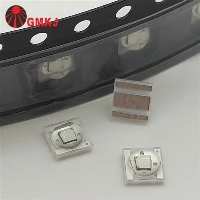
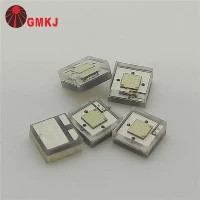


Guangmai Technology is proffesional in making the Epistar 660nm led Chip 1W 3W 5W Power.
LED lighting also has red and blue lights, but some people will ask the same red and blue LED lights, why the red and blue LED lights have no effect on plants, while the red and blue LED plant lights have effects?

I believe anyone who has done some research on plant supplementary lights knows that the photosynthesis of plants absorbs the most red and blue light. The wavelength of red light is between 620nm-780nm and the wavelength of blue light is between 450-480nm. But we have to understand that it is not only the red and blue light in the wavelength range that has an effect on the growth of plants. For example, red light with a wavelength of about 620nm has very little effect on plants, while red light with a wavelength of about 660nm has an effect on the growth of plants. Plants bring the greatest effect, as does blue light. Blue light with a wavelength range of 450-470nm has the greatest effect on plant growth. Therefore, if it is also a red and blue LED lamp, the red light wavelength of the LED lighting lamp is about 620nm, it has no effect to supplement the light, and the red light wavelength of the LED supplement light is about 660nm, and the wavelength of blue light is about 450- Between 470nm, the effect of supplementing light to plants is very obvious.

Product Specification
Typical Electrical & Optical Characteristics ( Ta = 25°C)

Package Dimension

Application methods of LED plant lighting:
Photosynthesis refers to the process by which green plants use light energy through chloroplasts to convert carbon dioxide and water into energy-storing organic matter and release oxygen. The key participant in this process is the chloroplast inside the plant cell. Under the action of sunlight, the chloroplast converts the carbon dioxide that enters the leaves through the stomata and the water absorbed by the roots into glucose and releases oxygen at the same time.
The photosystem in which the photoreaction occurs is composed of a variety of pigments, such as chlorophyll a (Chlorophyll a), chlorophyll b (Chlorophyll b), and carotenoids (Catotenoids). The main absorption spectra of chlorophyll a, chlorophyll b and carotenoids are concentrated at 450nm and 660nm, so in order to promote photosynthesis, the 450nm deep blue LED and the 660nm super red LED are mainly used, and some white LEDs are combined to achieve this. Efficient LED plant lighting.

About Guangmai LED

Datasheet:
Epistar 660nm led Chip 1W 3W 5W Power datasheet can be download from this page.
Hot Tags: epistar 660nm led chip 1w 3w 5w power, China, manufacturers, suppliers, factory, price, cheap, quotation, datasheet, specs, specification, rgb 3w, yellow diode, power led royal blue, 620nm led, green led diode, 3W green led


