

Driven by the new crown, Taobao and Jingdong already have many types of UV disinfection products.
As shown in the figure below, the industry generally divides ultraviolet rays into three categories: A, B, and C, namely, near ultraviolet (UVA), extreme ultraviolet (UVB) and ultra-short ultraviolet/deep ultraviolet (UVC). Among them, UVC has the largest energy and is harmful to microorganisms. Very destructive.
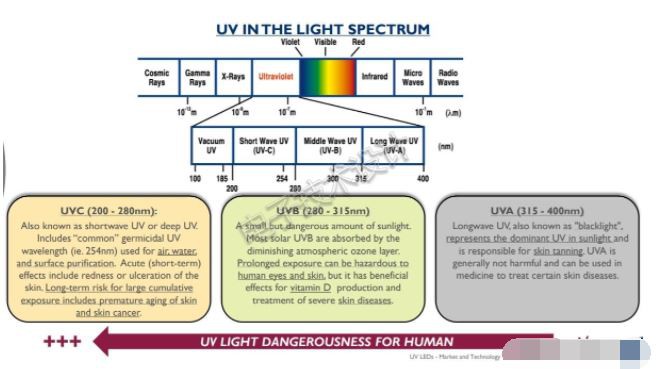
Compared with UVB and UVA, UVC is the first choice for health light sources; compared with chemical sterilization, UVC has the advantage of high sterilization efficiency and no other chemical pollutants.
China has a complete UVC semiconductor industry chain. UVC semiconductor puts forward higher requirements on chip, packaging technology and material performance. Chip technology is currently the main bottleneck and core competitiveness of deep ultraviolet semiconductor technology. The industry's leading manufacturers and UV LED segmentation The investment of leading companies in the field has continued to increase.
The epidemic has accelerated the development of the UVC semiconductor industry chain. The UVC market has grown from US$20 million in 2008 to US$100 million in 2015, and US$144 million in 2019. This year, it has directly doubled to US$308 million. According to the Yole Developpement report, driven by the coronavirus, the UVC market may reach US$2.5 billion in 2025, with a compound annual growth rate of 61% from 2019 to 2025.
From a domestic perspective, it is estimated that from 2020 to 2024, the market size of UVC sterilization modules in washing machines, refrigerators, household air conditioners, and UVC small appliances will rise from 174 million yuan, 185 million yuan, 194 million yuan, and 1.5 billion yuan respectively to 8.538 billion yuan, 8.927 billion yuan, 9.736 billion yuan and 3.5 billion yuan. It is estimated that by 2024, the market size of UVC sterilization modules in automobiles will reach 13.459 billion yuan.
If capacity can keep up with demand, this number may be even greater.
Compared with UVA and UVB, UVC is the first choice for sterilization applications
There are currently two main ways to obtain UVC for sterilization and disinfection: traditional mercury lamps and ultraviolet LEDs. Compared with traditional mercury lamps, UVC semiconductors have obvious advantages: miniaturization, non-toxicity, and convenient use.
In addition, the direction of UVC semiconductor process improvement is clear, and technical problems continue to break through.
Under this background, traditional ultraviolet mercury lamp disinfection and sterilization products will be quickly replaced by UV LEDs.
According to the Yole report, the UV LED market is mainly driven by UV curing applications. However, recently Taiwan and mainland manufacturers have entered the UVA LED industry in large numbers, causing strong price pressure, which limits the growth of the UVA LED market.

UVC sterilization principle
On the other hand, as equipment prices ($/mW) began to reach early demand, the UVC LED industry began to emerge. Yole Développement's solid-state lighting and display business unit manager Pars Mukish pointed out, “In fact, the price of UVC LEDs has gone from about US$100/mW in 2015 to US$0.3-2/mW in 2019. This is a major issue for most potential high-volume integrators. In terms of it, this is a real threshold."
The 2020 COVID-19 pandemic has played a role as a catalyst, creating some perfect use cases for the technology to be improved in a very short period of time.
Compared with UVA and UVB, UVC has weak penetrating power and will not cause harm to the human body, but the sterilization effect is almost the same, so UVC has become the first choice for sterilization and disinfection applications.
In 2020, there is an overall shortage in the entire UVC supply chain, and the industry is now looking for ways to rapidly increase production capacity.
The process of deep-ultraviolet semiconductors is roughly the same as that of ordinary LEDs, but because the luminescent materials of UV-LEDs are different, the selected luminescent materials and packaging forms will be different.
UVC semiconductor chips can be divided into two parts: substrate and epitaxial layer: the substrate usually follows the sapphire substrate used in blue LED chips. The epitaxial layer includes AIN template layer, N-type AIGaN layer, multiple quantum well light-emitting layer, electron blocking layer and P-type GaN contact layer.
In chip process, the N-type contact layer is leaked through lithography and etching, and the N-type and P-type are formed into ohmic contact with the electrode through evaporation and alloying, and then the small core particles are sorted by thinning and splitting, and then flipped to Insulating silicon chip.
After more than 10 years of research and development, the external quantum efficiency of deep ultraviolet semiconductors below 280nm has exceeded 5%, the corresponding luminous power is greater than 5mW, and the lifetime is 5000h.


