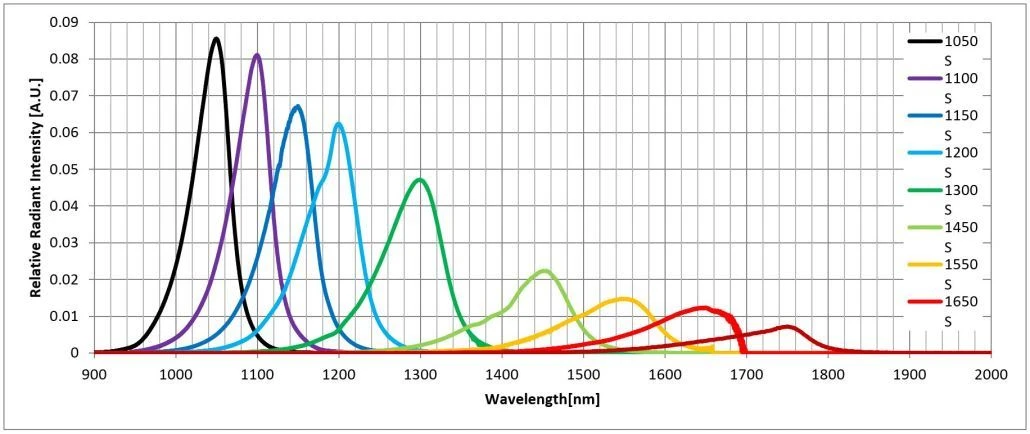
So far, SWIR LEDs have utilized low output. They have encompassed a fairly broad scope in the spectrum. Yet, new solutions have allowed a higher output in narrower spectrums that are more controlled. SWIR LEDs still have a wider spectrum and a narrower output compared to their counterparts in the visible range.
Moreover, SWIR LEDs can emit at wavelengths in the 1,050 to 2,500 nm range. They can supply high power. This makes them efficient in various new applications related to machine vision lighting. LEDs in the SWIR wavelength range have a configuration that is similar to those used in visible range applications. Their construction allows for easy and intuitive use and operation that is similar to standard LED lights.
In terms of operating principles, SWIR sensors utilize unique electronic and optical components. The primary sensors are built on chemical compositions like indium gallium arsenide (InGaAs). Moreover, many can utilize mercury cadmium telluride (MCT). Newer imagers for SWIR have also made use of quantum dot technology. However, with SWIR, the imaging capabilities and construction are dependent on the application. For example, wavelengths that are in the MWIR spectrum will benefit from MCT sensors.
Nevertheless, the prevailing technology still relies on InGaAs sensors. They are the most developed as well as the most affordable solution. They also produce high-resolution images that can interact with light much differently compared to traditional silicon imagers. This makes SWIR LEDs highly effective in applications like quality control, inspection, and sorting. They can also detect elements through fog, haze, and smoke.