

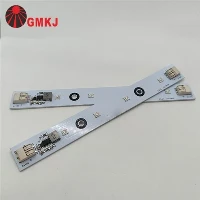
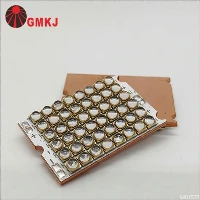


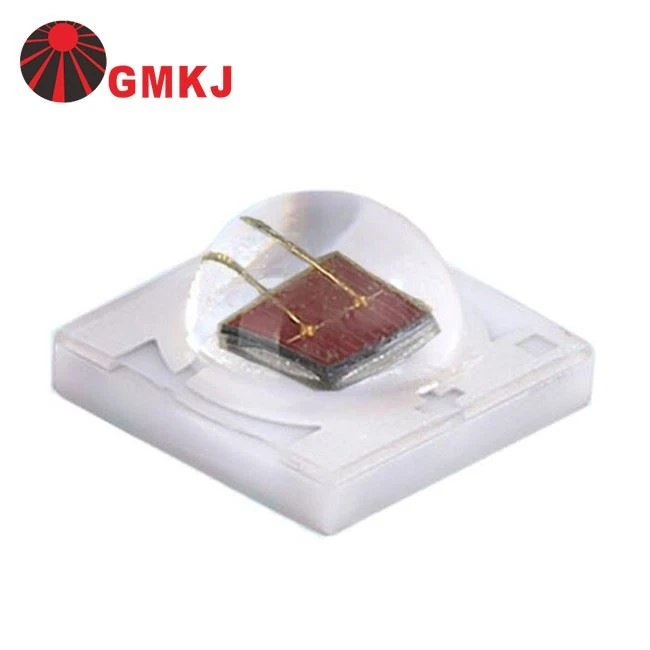


Advantage of GMKJ High PPF SMD LED Chip 3535 660nm for:
GMKJ LED have over 12 years LED Packaging experience.
High PPE PPF for horticulture lighting.
Oxide aluminum ceramic base, have good heat dissipation.
Flip chip ensure high stability and low temperature.
Viewing Angle (2θ1/2): Typical 30°,60° ,90°,120° for your choice.
Low light decay< 3% over 6000hrs.
Fast delivery time about 7days.

SMD3535 LED Dimension

SMD3535 LED Specification
Electrical/Optical Characteristics--White (At TA=25°C)

Why, as the fourth-generation new lighting source, LED has become the first choice for energy-saving and environmentally friendly light sources?
The LED used in the field of plant cultivation also exhibits the following characteristics: rich wavelength types, just in line with the spectral range of plant photosynthesis and light morphology; spectral wave width half-width narrow, can be combined according to needs to obtain pure monochromatic light and composite spectrum; can be concentrated The specific wavelength of light irradiates the crops in a balanced manner; not only can adjust the flowering and fruiting of the crops, but also control the plant height and the nutrients of the plants; the system generates less heat and occupies a small space. It can be used in a multi-layer cultivation three-dimensional combination system to achieve low heat load And miniaturization of the production space; in addition, its strong durability also reduces operating costs. Because of these remarkable features, LEDs are very suitable for plant cultivation in a controlled facility environment, such as plant tissue culture, facility gardening and factory seedlings, and aerospace ecological life support systems.
The area of facility horticulture in my country is developing rapidly, and the light environment control lighting technology for plant growth has attracted attention. Facility horticulture lighting technology is mainly used in two aspects: first, as supplementary lighting for plant photosynthesis when the amount of sunshine is small or short, and second, as inducing lighting for plant photoperiod and light morphology.
Research on LED application in plant facility cultivation:
1. Research on LED as supplementary lighting for plant photosynthesis. Traditional artificial light sources generate too much heat. If LED supplementary lighting and hydroponic systems are used, air can be recycled, excess heat and water can be removed, and electricity can be removed. Efficiently transform into effective photosynthetic radiation, and finally into plant matter. Studies have shown that the use of LED lighting can increase the growth rate and photosynthesis rate of lettuce by more than 20%, and it is feasible to use LEDs in plant factories. Studies have found that, compared with fluorescent lamps, mixed-wavelength LED light sources can significantly promote the growth and development of spinach, radishes and lettuce, and improve morphological indicators; it can maximize the bioaccumulation of sugar beet, and the most significant accumulation of betanin in hair roots, and is produced in hair roots The highest sugar and starch accumulation. Compared with the metal halide lamp, the pepper and perilla plants grown under the wavelength LED have significant changes in the anatomical morphology of their stems and leaves, and as the optical density increases, the photosynthetic rate of the plants increases. LEDs with multiple wavelengths can increase the number of stomata in marigold and sage plants.
2. LEDs are used as the induced lighting for the photoperiod and light morphology of plants. LEDs of specific wavelengths can affect the flowering time, quality and duration of the flowering period of plants. LEDs of certain wavelengths can increase the number of flower buds and flowering of plants; LEDs of certain wavelengths can reduce the flower formation response, regulate the length of the stalk and the flowering period, which is conducive to the production and marketing of cut flowers. This shows that LED regulation can regulate the flowering and subsequent growth of plants.
3. The application of LED in the research of aerospace ecological life support system. The establishment of a Controlled Ecological Life Support System (CELSS) is the fundamental way to solve the problem of long-term manned space life support. The cultivation of higher plants is an important component of CELSS, and the key is One light.
Based on the special requirements of the space environment, the light source used in the cultivation of higher space plants must have high luminous efficiency, output light waves suitable for plant photosynthesis and light morphogenesis, small size, light weight, long life, high safety and reliability records and no environment Pollution and other characteristics. Compared with other light sources such as cool white fluorescent lamps, high-pressure sodium lamps and metal halide lamps, LEDs are more effective in converting light energy into photosynthetically effective radiation, and plants have a better light supplement effect; in addition, it has a long life, small size, light weight and It is solid and other characteristics, therefore, LED is paid more attention to in ground and space plant cultivation. Studies have shown that LED lighting systems can provide lighting with uniform spectral energy distribution, and the efficiency of converting electrical energy into light required by plants is more than 520 times that of metal halide lamps.
Company information:

GMKJ LED was founded in 2009, which is located in LED industry base in Shenzhen Baoan, China, is a high-end technology development, high-power SMD packaging, LED lighting solutions research and marketing as one of the national high-tech enterprises.
Samples of High PPF SMD LED Chip 3535 660nm are available for you!
Hot Tags: high ppf smd led chip 3535 660nm, China, manufacturers, suppliers, factory, price, cheap, quotation, datasheet, specs, specification, 730 nm light, amber led 12v, uvc led 265 nm, 730nm led light, 400nm led, RGBW SMD LED


