

Color wavelength and application introduction of common LED chips
1. Blue LED
Refers to the blue light-emitting diode. Gallium nitride (GaN)-based semiconductors are commonly used as materials for blue LEDs. The development of blue LEDs using zinc selenide (ZnSe)-based semiconductors has previously been popular, but since the development of high-brightness blue LEDs using gallium nitride-based semiconductors in December 1993, the mainstream of blue LEDs has become GaN-based semiconductor products.
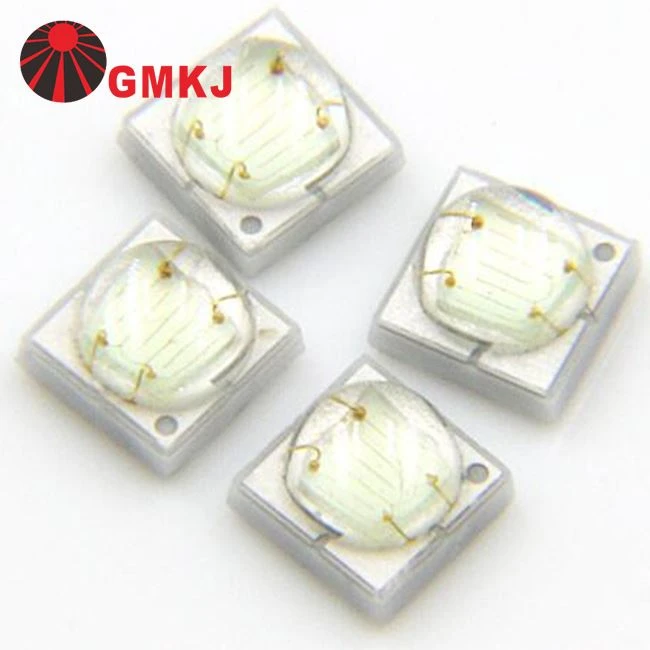
The center of the emission wavelength of a gallium nitride (GaN)-based blue light-emitting diode is around 470 nm. It is used for the light source of blue display parts such as lighting fixtures and indicators, the blue light source of LED display screen, and the backlight light source of liquid crystal panel, etc. When used in combination with phosphor materials, white light can be obtained. The current white LED generally adopts a structure in which a blue LED is combined with a fluorescent material.
2. Red LED
red-emitting diode. At present, the commonly used materials for red LEDs are aluminum indium gallium phosphide or aluminum indium gallium phosphide (AlInGaP) compound semiconductors. In the field of LEDs, quaternary materials generally refer to AlInGaP. AlInGaP is called quaternary materials because it uses four elements: aluminum (Al), gallium (Ga), indium (In) and phosphorus (P). AlInGaP doesn't just refer to red, it also covers the wavelength range from red to yellow.
Before the advent of AlInGaP, GaAs semiconductors were the mainstream materials. The liquid phase epitaxy growth technology is used. Since the 1990s, the vapor phase epitaxy growth technology represented by the MOCVD method has progressed, and the quality of the crystal has been improved as a result of the rapid increase in the brightness of AlInGaP.
The central wavelength of red LED light emission is about 620-630 nm. It has a wide range of applications and is mainly used for the light source of the red display part of neon lights, indicators, automobile tail lights and signals, the red light source of LED displays, and the backlight light source of liquid crystal panels.
3. Green LED

A diode that emits green light. The gallium nitride (GaN)-based semiconductor materials mainly used in green LEDs are less efficient than those used in blue LEDs, and the light output power is lower for the same input current. The reason for the low efficiency of GaN-based semiconductor green LEDs currently sold is mainly due to the piezoelectric field. The piezoelectric field refers to an electric field generated by piezoelectric polarization caused by the stress of the crystal structure. Universities and LED chip manufacturers in Japan and abroad have started researches on changing the growth plane of GaN crystals to greatly improve efficiency. If the crystal planes of GaN-based semiconductors are changed, it is possible to increase the efficiency of green LEDs to the current 2 times more.
In order to modulate a high brightness and balanced white color on the market, taking into account the visual sensitivity of the human eye, the RGB color mixing method is often used, and when combined with red LED, green LED and blue LED to form the backlight source of LED display or LCD panel, RGB three are used. The distribution ratio of color LED light quantity needs to be about 3:6:1 or about 3:7:1. Due to the insufficient brightness of green LEDs, multiple green LEDs must be used to increase the output power. Compared with red and blue LEDs, green LEDs are considered to have much room for improvement.
Green LED, the central wavelength of light emission is about 560nm. It is commonly used as the light source of the green display part of neon lights and indicators, LED displays, etc., as well as the backlight light source of liquid crystal panels, etc.
4. Infrared LED
As the name suggests, it refers to a diode that emits infrared light. Gallium arsenide (GaAs) semiconductor materials such as aluminum gallium arsenide phosphide (AlGaAsP) are commonly used. Infrared LED has a long history. In 1962, it was discovered that the pn junction of III-V compound semiconductor represented by gallium arsenide (GaAs) can emit electromagnetic waves equivalent to infrared light.

Infrared LEDs have a forward voltage of about 1.5V, which is low compared to over 2V for red LEDs and over 3V for blue LEDs. Infrared LEDs with emission wavelengths over 700nm are mostly used as light sources for infrared remote control line communication, ranging sensor light sources, optocoupler light sources, and light sources for printer heads.
5. Ultraviolet LED
A diode that emits UV light. Ultraviolet LEDs mainly use gallium nitride (GaN) semiconductors. Usually refers to LEDs with emission wavelengths below 400nm, but sometimes referred to as near-ultraviolet LEDs when the emission wavelengths are greater than 380nm, and as deep-ultraviolet LEDs when the emission wavelengths are shorter than 300nm. Short-wavelength light has a good sterilization effect, so ultraviolet LEDs are often used for sterilization and deodorization of refrigerators and home appliances, as well as LEDs that emit visible light in combination with phosphors. White LEDs can also be obtained, for example by combining red, green and blue phosphors with UV LEDs.


