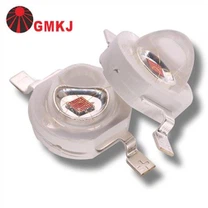
What are the advantages of high power LED and SMD LED?
As a lighting source, high-power LEDs have the advantages of small size, low power consumption, low heat generation, long life, fast response speed, safe low voltage, good weather resistance, and good directionality. The outer cover can be made of PC tube, which can withstand high temperature up to 135 degrees and low temperature -45 degrees. As the fourth-generation electric light source, high-power LED is known as "green lighting source". It has excellent characteristics such as small size, safe and low voltage, long life, high electro-optical conversion efficiency, fast response speed, energy saving, and environmental protection. It will definitely replace the traditional Incandescent lamps, halogen tungsten lamps and fluorescent lamps have become a new generation of light sources in the 21st century.
Comparison of high power and standard power LED products:
1. Simplify the design process
The design process required for standard LED arrays is much simpler than that required for high-power technologies due to the need to consider simplified thermal management. High-power technologies require the use of heat sinks and metal-core PCBs to ensure that efficiency losses, reduced lifetime, or discoloration due to excessive junction temperatures are avoided.
Because standard LEDs do not require the use of heat sinks, metal core printed circuit boards (MCPCBs), capacitors or resistors, these LEDs are easier to design, test and manufacture. This simplified process not only saves time and money in the production process, but it also speeds time to market.

High Power LED
2. Cost saving
High-power LEDs require thermal management, which increases the cost of LEDs. The more expensive addition to the design process is the heat sink. Heat sinks can be made from a variety of metallic materials, ranging from relatively inexpensive aluminum to more conductive but more expensive materials such as copper and silver. These expensive materials can add $1 to $10 to the cost of high-power products that standard LED devices can avoid.
Likewise, high-power LEDs require the use of MCPCBs as another passive cooling technique to control junction temperature. Because the material of the MCPCB has better thermal conductivity, these boards can dissipate heat more efficiently than the cheaper FR4 PCBs used for standard LEDs. However, the cost can be as much as 5 times the cost of an FR4 PCB.
3. Save space
Standard LEDs are often the best choice when the interior space constraints of the device are very large. As mentioned above, high-power LEDs require the additional use of heat sinks and generally more space-consuming cooling techniques. Its first task is to create more surface area for cooling by convection and radiation. The larger surface area can help reduce heat more effectively, but it also increases the bulk of the high-power LED. This increases design hurdles for smaller spaces and smaller products.
Standard LED arrays typically do not require the space-consuming drivers, capacitors and resistors required for high-power LEDs, saving up to 50% of space. For space-constrained applications, standard LED arrays can provide the same brightness as high-power LEDs while saving space.