





A considerable part of energy use is used for lighting, so MIT scientists are developing a new passive lighting - noctilucent plants. In the latest experiment, the team has made them emit brighter light than the first generation plants without damaging their health. The emerging field of "plant nano bionics" involves embedding nanoparticles into plants to give them new capabilities.
Past work by the MIT team has created plants that emit light. Now, researchers have raised the brightness to a more practical level. The light produced by these plants is 10 times brighter than the first generation of luminous plants reported by the research team in 2017.

"We want to create a kind of luminous plants, which will absorb and store some light, and then gradually release it," said Michael strano, a professor of chemical engineering at MIT. "This is a big step towards plant lighting."
Strano and his collaborators want to create components that extend the duration of light and make it brighter. They came up with the idea of using capacitors, which are part of a circuit that can store electrical energy and release it when needed. For luminescent plants, photoelectric containers can be used to store light in the form of photons and then gradually release light over time.
In order to create their "photoelectric container", the researchers decided to use a material called phosphor. These materials can absorb visible or ultraviolet light and then slowly release them in the form of phosphorescence.
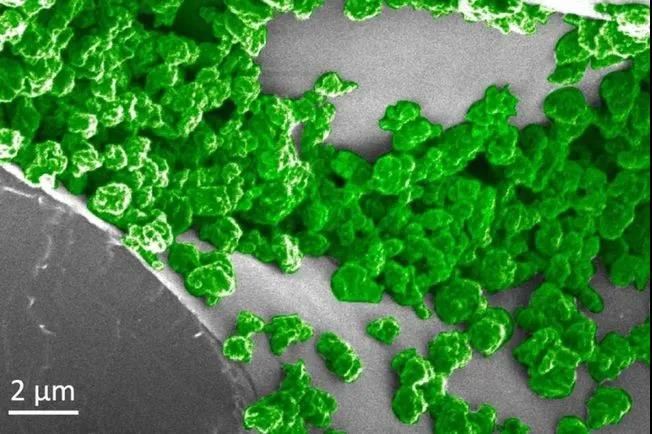
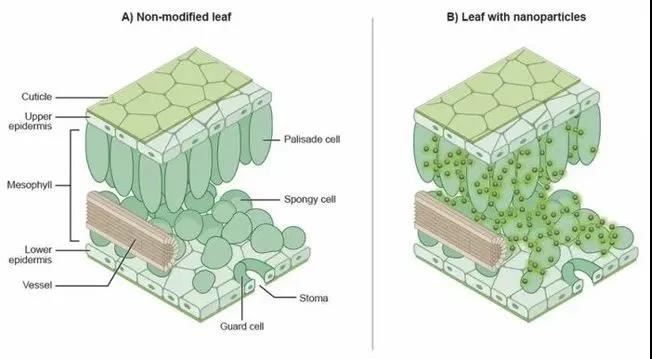
The researchers used a compound called strontium aluminate as a phosphor, which can form nanoparticles. Before implanting them into plants, the researchers wrapped the particles in silica to protect the plants from damage. These particles with a diameter of hundreds of nanometers can enter the plant through pores (small pores on the leaf surface). These particles gather in a spongy layer called mesophyll, where they form a thin film.
The team tested the technology on a series of plants, including cress, tobacco, basil, Daisy and elephant ears, and found that plants glow for an hour after exposure to blue LED lights for only 10 seconds. As might be expected, the light is the brightest in the first few minutes and then darkens in the next hour.
Importantly, the implantation of nanoparticles did not damage the normal functions of plants, such as photosynthesis and evaporation of water through their leaves.
They also proved that this method can illuminate the leaves of a plant called Thai Elephant Ear, which may be more than 1 foot wide and can be used as an outdoor lighting source.
The team said that the ultimate goal is to try to develop luminous plants that can be used to passively illuminate streets or other public areas, so as to reduce the energy consumption of street lamps. The next step to achieve this goal is to combine the new strontium aluminate nanoparticles with the early luciferase, hoping to make the luminescence brighter and more lasting.

If living plants can become the starting point of advanced technology, plants may replace our unsustainable urban power and lighting network, benefiting all plant dependent species, including people.
"We need a strong light that can be transmitted in the form of pulses for a few seconds so that it can be charged," said Pavlo gordiichuk, the lead author of the paper and the Massachusetts Institute of technology. "We also prove that we can use large lenses, such as Fresnel lenses, to transmit the amplified light over a distance of more than 1 meter. This is a good step towards creating large-scale lighting that people can use."
The study was published in the journal progress of science


