
On December 23, a research group from the Department of New Materials Engineering at Pohang University of Technology announced that they have fabricated a new type of LED element that emits deep ultraviolet light based on a sandwich structure of graphene layers and hexagonal boron nitride (hBN) layers. . The research team explained that so far, devices that emit deep ultraviolet rays have mainly used components made of mercury or aluminum gallium nitride, but these traditional components have problems with pollution or luminous efficiency. The research results were recently published in the world-renowned academic journal Nature Communications.
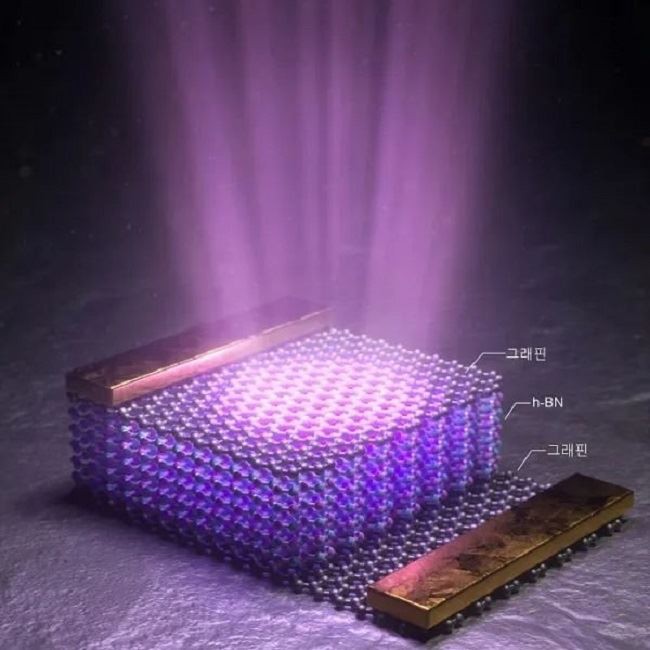
▲ h-BN deep ultraviolet LED. Schematic showing strong deep ultraviolet emission using graphene, h-BN, and van der Waals heteronanomaterials with graphene structures (C)
According to Pohang University of Technology, the main material currently used in deep ultraviolet LED research is aluminum gallium nitride (hereinafter referred to as AlxGa1-xN). However, this material has a fundamental limitation that its luminescent properties deteriorate rapidly as the wavelength gets shorter.
In order to break through this limitation, POSTECH uses h-BN as a device material, whose single-atom layer structure is similar to graphene and its appearance is transparent, so it is also called "white graphene".
It is reported that, unlike AlxGa1-xN, it emits bright light in the deep ultraviolet region and is considered to be a new material that can be used to develop deep ultraviolet LEDs. However, due to the large band gap, it is difficult to inject electrons and holes, so LEDs cannot be made. But if a strong voltage is applied to the h-BN nanofilm, electrons and holes can be injected through the tunnel effect. Therefore, LED devices based on the stacking of van der Waals heterogeneous nanomaterials with graphene, h-BN, and graphene were fabricated, and it was confirmed by deep UV spectroscopy that the actual device emits strong UV light.
Professor Jin Zhonghuan from the Department of Materials Science and Engineering of the university said: "The development of new high-efficiency LED materials in a new wavelength range can be a starting point for the application of optical devices. The significance of this research on h-BN lies in the realization of deep ultraviolet LED manufacturing. .
In addition, compared with the existing AlxGa1-xN material, it has significantly higher luminous efficiency, and the device can be miniaturized. "