

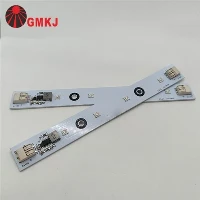
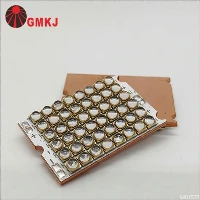


3535 led 650nm 660nm deep red grow lighting
LED Packaging Size:3.5*3.5*1.5mm
Oxide aluminum ceramic base,good heat dissipation.
Viewing Angle (2θ1/2): Typical 30°,60° ,90°,120°
Flip chip ensure high stability and low temperature.
Low light decay< 3% over 6000hrs.
over 12 years LED Packaging experience
TOP10 LED Manufacturer in China
Fast delivery time 3-7 workdays.
Hot sale for horticulture lighting
SMD3535 LED Dimension

SMD3535 LED Specification
Electrical/Optical Characteristics--White (At TA=25°C)
Parameter | Symbol | Conditions | Min | Avg. | Max | Units |
Forward Voltage
| VF | IF=1000mA | 1.8 | -- | 2.0 | V |
Thermal Resistance Junction To Board
| RΘJ-B | IF=1000mA | -- | 8 | -- | °C/W |
Luminous Flux
| Φe | IF=1000mA | 60 | 80 | lm | |
Peak wavelength
| λp | IF=1000mA | 650 | 660 | nm | |
Temperature Coefficient of Forward Voltage
| ∆VF/∆T | IF=1000mA | −− | -2 | −− | mV/°C |
Reverse Current
| IR | VR=1000V | −− | −− | 10 | μ A |
Viewing Angle [1]
| 2Θ1/2 | IF=1000mA | −− | 120 | −− | Deg |
The effects of light on plants are mainly manifested in two aspects
One is to provide radiation energy for plant photosynthesis;
Second, as a signal, it regulates many physiological processes in the whole life cycle of plants.
Customized light formula of LED plant lighting
LED used for horticultural lighting, can promote plant growth speed up to 40% or flexible control of flowering. Due to the independence of single LED, the lighting performance can be easily controlled in the greenhouse.
The photosynthetic photon flux (PPF) of LED is very high, dark blue (450 The results show that the typical PPF luminous efficiency of the LED with light intensity of 0.5 nm and 730nm is about 2.3? Mol / J, and the typical PPF luminous efficiency of the LED with light intensity of 660nm is about 3.1? Mol / J. in addition, the wavelengths of these LEDs match the absorption spectra of chlorophyll a / B, carotenoid and photosensitive pigment PR / PFR very well, which can achieve efficient lighting and significantly reduce energy consumption.
LED will not radiate heat in the direction of lighting and will not damage plants. It is suitable for top lighting, interior lighting and multi-layer cultivation. R / FR ratio is the ratio of red light (660 nm) to far red light (730 nm). R / B ratio is the ratio of red light (660 nm) to blue light (450 nm). By controlling the R / FR ratio and R / B ratio, the best customized light formula for various plants can be achieved.
Deep red LED plant lighting technology
Since the mature development of LED technology into lighting applications, it will soon enter the plateau period of growth, traditional lighting companies will focus on other niche lighting applications. Plant lighting has become a new favorite of the industry. The introduction of auxiliary artificial light source in plant planting is a long-standing technology in agricultural industry. LED lighting technology provides more energy-saving and flexible lighting design options in the plant lighting industry. Compared with traditional lighting, what breakthroughs can LED technology bring to the application of plant lighting? What are the current popular market application trends? In order to answer these questions, OSRAM, the leading manufacturer of global plant lighting market, is led by Alessandro, the global marketing leader of OSRAM Opto Semiconductor Cilano, to share the market trends and technical features of plant lighting. 1. OSRAM takes the lead in the industry and continues to break through the luminous efficiency of red LED Cilano first pointed out the advantages of LED technology in plant lighting. Compared with traditional halogen lamps, high pressure sodium lamps and incandescent lamps, in addition to the well-known led features such as more efficient, more energy-saving, longer service life, less heat dissipation problems and smaller size, which can increase the flexibility of lamp design, spectrum control is the key. "Just as human factors lighting can boost the spirit or improve sleep by adjusting the LED spectrum, led plant lighting can also improve the growth efficiency of plants by finding the right wavelength." Cilano said that by adjusting the spectrum, led plant lights can provide specific wavelengths to make crops grow into the desired color, shape, and even stimulate more nutrients. The key light source for plant growth is the red light with the wavelength range of 640 to 700nm, and the hyper red light with the wavelength of 660nm is the most helpful for plant growth. OSLON's technical strength lies in its ability to provide the industry's most efficient 660nm red LED product, OSLON square hyper red.
When it comes to this unique tool that dominates plant lighting applications, cilano points out that OSRAM's latest generation of ultra red LEDs can achieve 73% photoelectric conversion efficiency at 1035mw. For the LED industry, improving the luminous efficiency of red LED is always a challenge. OSRAM, with more than 40 years of experience in LED technology, has transferred its strong technical strength into the application of plant lighting, and created super efficient red light products through full power LED, meeting professional needs and assisting in the development of customized solutions. 2. Science and technology agriculture has become a new investment target, and the demand for plant lighting is rising. In recent years, various environmental problems caused by climate change and population concentration have given birth to more new agricultural science and technology development. In the urban or severe climate environment, the construction of plant factory or indoor planting field with water tillage vertical agricultural technology has become the development focus of many countries and cities. The closure of the city caused by the New Coronavirus epidemic this year has made many countries and regions which are highly dependent on food imports. In order to ensure food stability, they are determined to develop science and technology agriculture, and the demand for plant lighting has also reached a new high. In the first three quarters of this year alone, the United Arab Emirates announced that it would invest US $10 billion to start the vertical farm project in the region. Many new start-up companies of science and technology agriculture, including freight farm, a container grower in the United States, and infirm, a vertical agricultural company in Germany, have successively received large amounts of funds. In the face of this upsurge, cilano said frankly that the whole industry is witnessing a critical growth period of plant lighting. As a technology leader, OSRAM's plant lighting business is booming with the market heat. With the highest technical products in the industry, OSRAM has always cooperated closely with the plant lighting industry, and continued to meet the needs of customers, thinking about how to integrate the power supply, optimize the lamp design, and improve the wavelength consistency, so that the existing LED light source can play the maximum effect. 3. Aiming at the growing trend of indoor planting, cilano explained that compared with providing supplementary light sources for greenhouses, most of them are red light. Vertical farms and plant factories can't get sunlight at all, so they also need to add white light to strengthen the plant lighting sources. Therefore, in addition to red light, white light is gradually introduced into the application. Cilano pointed out that indoor growth lamps combined with red and white light can best meet the growth needs of different plants.
"OSRAM's advantage is that it has accumulated profound technical experience in vehicle use and red light. Seeing the demand of plant lighting, OSRAM can quickly adopt existing products and technologies to create led suitable for plant lighting." Cilano further stressed that OSRAM's technology development, chip manufacturing and packaging all come from its own factories to ensure that the LED products provided can achieve the highest luminous efficiency, especially OSRAM's original 660nm hyper red technology. OSRAM will continue to cooperate with plant lighting leaders in the global market. The solutions currently provided by OSRAM have been widely used in the emerging plant factory projects in the United States, Europe and Asia. OSRAM also continues to invest in R & D to optimize luminous efficiency and launch innovative products. It is expected that by the end of this year, there will be products targeting plant lighting applications on the market, and it is also expected that the momentum of the plant lighting market will continue to strengthen.
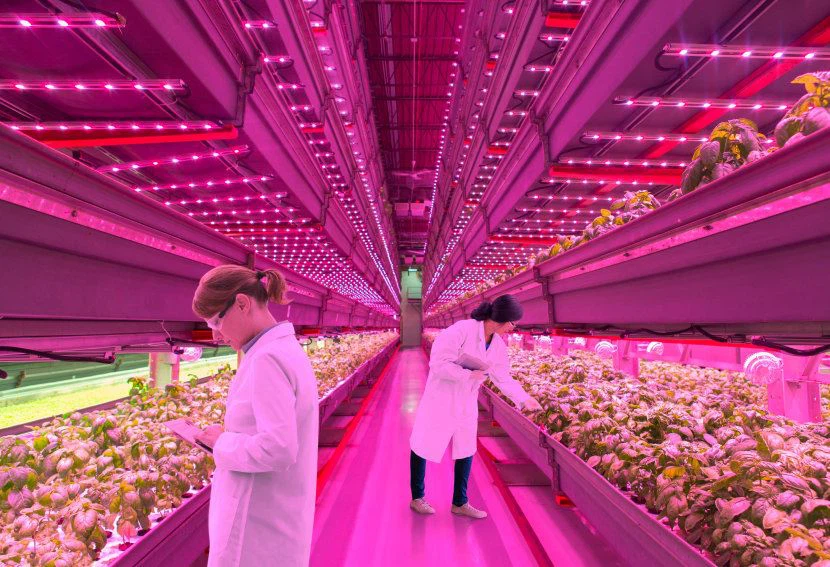
Hot Tags: smd 3535 led 650nm 660nm deep red grow lighting, China, manufacturers, suppliers, factory, price, cheap, quotation, datasheet, specs, specification, 650NM LED Red 2835 Plant Grow, ir smd, 395NM LED, LED Type Smd 5050 RGB, convoy s2 uv review, nichia uv


