

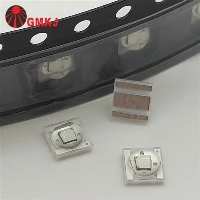
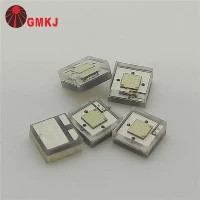


Guangmai Technology is professional in making the SMD 3535 uvc led 260-270nm for water purify.
Is UVC harmful to human body and how to protect it?
This is a more classic problem. UVC deep ultraviolet is not harmful to human skin, but it is more harmful to human eyes. A typical UVC-LED's ultraviolet light with a wavelength of 275 nm is almost 97% absorbed by the stratum corneum of the human skin, and more than 99.9% is absorbed by the stratum corneum and epidermis, and very little light hits the dermis. Ultraviolet rays only affect the dermis to cause skin cells to become cancerous. Therefore, it is generally believed that UVC has little effect on human skin. Of course, baby skin, including some human skin, has a thinner stratum corneum, and its resistance to UVC ultraviolet rays is even worse. Human eyes have no cuticle protection. Direct UVC ultraviolet rays will cause lens and corneal disease. Therefore, it is forbidden to look directly at the lit UVC-LED lamp beads.
The shorter the wavelength of light, the worse the penetration ability, which is determined by the wave-particle duality of light. Of course, when it comes to matter, it is also related to absorption. Is UVC harmful to human body? The easiest answer is, yes, do not expose to UVC ultraviolet rays. But in fact, there is a big misunderstanding in this, that is, UVA, such as 365, 385, 395 is very harmful to human skin, because this wavelength of ultraviolet light can penetrate the human dermis, causing skin cell cancer.
However, UVC ultraviolet rays, such as 275nm, have a much shallower transmission depth in the epidermis of adults. After penetrating the stratum corneum, more than 97% of the energy will be absorbed, and the energy that finally penetrates into the dermis is not even 0.1%. Therefore, to be precise, UVC deep ultraviolet is not harmful to human skin, and human eyes without stratum corneum are much more dangerous. Of course, long-term exposure to weak light is also harmful to the human body.
So don't be blindly afraid of UVC deep ultraviolet rays, because the short-term skin damage can be ignored; don't try your own risk, staring at the LED will definitely cause eye injuries.

How to choose the light window material for deep ultraviolet LED applications?
When designing the scheme, the client mistakenly believed that common transparent plastics such as acrylic in the design of visible light schemes could also be used as light windows for UVC-LEDs, resulting in zero sterilization. This situation is not uncommon. Borrowing the concept of bond energy, the absorption coefficients of C-H and C-O bonds in the UVC and UVB bands are very high, so very thin plastics can absorb almost all deep ultraviolet rays. The absorption edge of ordinary polystyrene and acrylic is about 385nm, and the transmittance at 275nm is already equal to zero.
What kind of material should be used to make the light window of the deep ultraviolet LED? Sapphire is the substrate of the deep-ultraviolet LED and the light-emitting surface of the chip, so it can be used as a light window, but the material and processing costs are high. There are many types of quartz. There are three common types of optical glass, JGS123. It is recommended that the 275nm UVC-LED can use the JGS2 specification quartz, and the 265nm or less LED needs to use JGS1 quartz or sapphire. This also applies to the lens material of the lamp bead package.

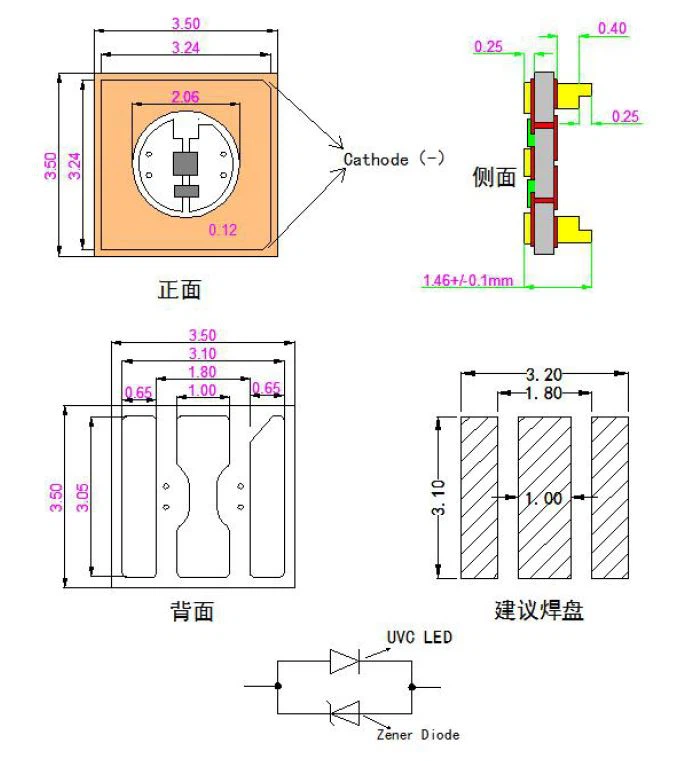
SMD 3535 uvc led 260-270nm for water purify package size:


SMD 3535 uvc led 260-270nm for water purify application

About Guangmai LED/ GMKJ LED

Datasheet:
For more details, please feel free to contact with Guangmai Tech directly.
You can download the English Version datasheet of SMD 3535 uvc led 260-270nm for water purify from the head of this page.
Hot Tags: smd 3535 uvc led 260-270nm for water purify, China, manufacturers, suppliers, factory, price, cheap, quotation, datasheet, specs, specification


