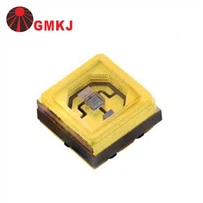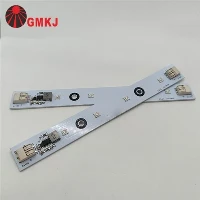
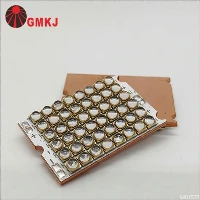


UV-C LEDs 222NM 265NM 275NM
Item Name: 265nm 270nm 280nm uvc smd led
Model Number: GG-3535UVC-1008
Input Current: 100-150mA
Power: 1 Watt
Input Voltage: 5-8VDC
LED package type: 3535 AlN ceramic
Chips brand: Taiwan Epileds or Korea LG
Chip size: 20*20mil
Wavelength: 265-280nm
Emitting Power: 16-18mW
Ultraviolet LED technology and its impact on public healthUV radiation consists of a fairly broad spectrum, ranging from 10 nm up to 400 nm, just below our visible spectrum. And while UV lamps and LEDs have a variety of uses such as curing, material inspection, and tanning, the 200-nm to 400-nm range is used for most sanitization applications. Many instruments containing UV technology have been developed specifically for sterilization, so let’s take a look at the design methodologies along with the challenges and considerations and how it’s made such a major impact on minimizing the spread of diseases.A brief history of UV-C technology
While UV radiation has been recognized since the turn of the 19th century, it wasn’t until about 80 years later that it was discovered to, under certain conditions, kill bacteria due to its short-wavelength light (which turns out to be most effective at about 250 nm). This range is generally known as UV-C and, at certain levels of intensity and exposure, kills micro-organisms by eliminating critical nucleic acids and disabling their DNA and RNA structures.
This method of disinfection has been used for a wide variety of health-related applications, such as wastewater treatment, air filtration and purification, disinfecting food, and for general sterilization of medical equipment. UV-C light kills bacteria such as Clostridium difficile, one of the most common bacteria that are found in hospital environments and contribute to as many as 15,000 deaths a year. Despite its many positive attributes, there are some dangers associated with UV-C, particularly around human skin and eyes.
Most recently, there’s been interest in designing UV-C – based products for personal use; however, these hazards make it difficult to sell an approved device. In addition to human health hazards, this specific wavelength also breaks down some chemical bonds in several materials, including plastics and insulation, and so has many adverse effects that must be mitigated. But that aside, let’s look closely at the LEDs and lamps generating this light and how it can be controlled.Driving and controlling UV-C technology
For the most part, UV-C LEDs work the same way as a normal LED, except they have a much larger forward voltage due to the high bandgap energy (the minimum energy needed to excite electrons across the conduction/valance bandgap) associated with their much smaller wavelength. Typically, with higher wavelengths come higher amounts of energy needed to emit light.
Getting larger voltages for small, handheld devices can be cumbersome and require boost converters. Fortunately, controlling the LED works the same way, including dimming or adjusting brightness/intensity. There’s a variety of ways to do this, including the use of a MOSFET with a driver, current-limiting resistor, and the voltage source, which needs to be high enough to account for the forward voltage, plus a little headroom.
An example of this can be seen in Figure 1, which consists of a MOSFET driver that allows for a TTL interface, an N-channel MOSFET, connection for the LED, and a current-limiting resistor, which puts a cap on the max current going into the LED to help prevent burnout.

This method will provide you with the bare minimum needed to drive and control an LED. If, however, you require additional protection and power management is needed, using a dedicated LED driving IC (such as the LED6000 IC from STMicroelectronics, shown in Figure 2) can be well worth the cost, especially for higher-power applications.
GMKJ UVC SMD LED main product:
 |  |  |
| 0.5W and 1W 3535 uvc smd led | 4w and 8w 6868 uvc smd led | 4040 60 degree lighting angle uvc smd led |
3535 1W UVC SMD LED specs:
■ Electrical/Optical Characteristics--White (At TA=25°C)
Parameter | Symbol | Conditions | Min | Avg. | Max | Units |
Forward Voltage | VF | IF=150mA | 5.00 | -- | 8.00 | V |
Thermal Resistance Junction To Board | RΘJ-B | IF=150mA | -- | 8 | -- | °C/W |
Radiant Flux | Φe | IF=150mA | 16 | 20 | mW | |
Peak wavelength | λp | IF=150mA | 265 | 280 | nm | |
Temperature Coefficient of Forward Voltage | ∆VF/∆T | IF=150mA | −− | -2 | −− | mV/°C |
Reverse Current | IR | VR=10V | −− | −− | 10 | μ A |
Viewing Angle [1] | 2Θ1/2 | IF=150mA | −− | 100 | −− | Deg |
Package dimensions:

About GMKJ:

Packing & Delivery
1. Payment: T/T only 30% deposits before production, 70%balance to be paid before deliver.100% T/T for the samples.
2. Production Lead Time for: 5~7days
3. Shipping method: As your requests, By Express( DHL,EMS,FedEX,UPS,TNT ,Marine and Air transport Available),By Air ,By sea are optional
4.Shipping port: Shenzhen or Hongkong Mainland China
5.Discounts are offered based on order quantities.

Hot Tags: uv-c leds 222nm 265nm 275nm, China, manufacturers, suppliers, factory, price, cheap, quotation, datasheet, specs, specification